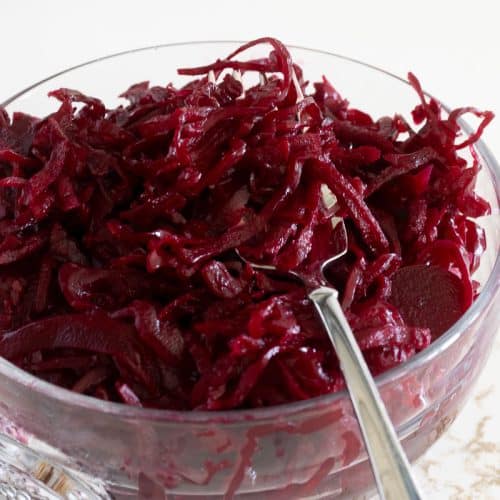
Beet Sauerkraut
This beet sauerkraut is a simple, two-vegetable ferment that produces a tangy, earthy kraut with a deep magenta color that looks striking in the jar and on the plate. Red cabbage brings the familiar sour bite you expect from sauerkraut, and red beets add a subtle sweetness and earthiness that rounds it out. Sliced garlic works its way through the whole thing as it ferments.This kraut is naturally rich in probiotics, making it a genuinely good-for-you addition to meals. Unlike most store-bought sauerkraut, which is pasteurized and shelf-stable, homemade kraut is alive with active cultures right up until you eat it. It takes about 30 to 45 minutes of hands-on time and a kitchen scale.
Ingredients
- 1 head red cabbage
- 2 pounds red beets
- mineral or sea salt Note 1
- 3-4 cloves of garlic, sliced thin
As needed
- 1 tsp mineral or sea salt
- 1 cup non-chlorinated water
Instructions
- Prep your vegetables: Wash your veggies in water, but avoid using a vegetable cleaner. Shred red cabbage and red beets using a box grater, food processor, or mandoline. Aim for thin, even shreds — about 1/8 inch. Thin shreds ferment more evenly and give you a better texture in the finished kraut. See Note 2 about washing vegetables.
- Weigh your vegetables: Place a large bowl on your kitchen scale, set the tare to zero,and grams as the unit. Add the shredded cabbage and beets to the bowl and weigh. Write down that number. Multiply that number by .02 to determine how many grams of salt you need. (In my case, the combined weight of my shredded beets and cabbage was 2,148 grams. 2,148 X .02 equals 42.96 (43) grams of salt. Weigh out your salt and sprinkle it over the cabbage/beet mixture. Using clean hands, massage and squeeze the mixture firmly for 3 to 5 minutes. By massaging the cabbage and beets with the salt, you are breaking down the cell walls to draw out the natural liquid, which becomes your brine. Don't rush this step — the more liquid you draw out now, the less likely you are to need a supplemental brine. The mixture will shrink down significantly and turn a deep magenta color.
- Rest and check your brine: Let the massaged mixture rest for 30 minutes, then check the liquid at the bottom of the bowl. You want a good pool of brine — at least a quarter cup. If you have it, you're in great shape. If the liquid seems scant, let it rest another 10 minutes before deciding whether you need supplemental brine.
- Pack your jars: Distribute your thinly sliced garlic in the bottom of clean wide-mouth quart jars — roughly 1 clove per jar. Add the cabbage-and-beet mixture on top of the garlic, packing it down firmly with your fist or a kraut pounder as you go. The goal is to eliminate air pockets and encourage the brine to rise above the vegetables. Pour any remaining brine from the bowl into the jars.
- Add your weight and check the brine level: Press a weight — a small zip-lock bag filled with brine, a dedicated fermentation weight, or even a zip-lock bag filled with water — onto the packed vegetables. The vegetables must be fully submerged under the brine — that is the non-negotiable part. The weight itself does not need to be fully submerged, though in a well-packed jar with plenty of brine it often will be. It just needs to sit on top of the vegetables and hold them down below the liquid. Leave 2 inches of headspace between the brine surface and the top of the jar to allow for bubbling and expansion during fermentation. If the vegetables are not fully covered after packing, make a quick 2% brine: dissolve 1 tsp of salt in 1 cup of non-chlorinated water (filtered or left to sit overnight) and add just enough to submerge the vegetables completely.
- Cover and begin fermentation: Lay one of the reserved cabbage leaves over the fermented veggies before placing your weight, if you like — this helps keep any small shreds from floating above the brine. Pick or scoop out any random shreds of cabbage or beets that float to the top, as they will mold. Cover the jar loosely with a cloth, a coffee filter secured with a rubber band, or a loose lid. Do not seal it airtight, as the fermentation process produces CO2 that needs to escape. Set the jars on a small plate or tray to catch any overflow, and keep them at room temperature, ideally between 65℉ and 75℉ (18℃ to 24℃) and out of direct sunlight.
- Ferment and taste daily: Check your kraut every day. Press the vegetables down if they have risen above the brine, and skim off any white foam that forms on the surface — this is normal and harmless, but you want your vegetables under the brine at all times. You may see small bubbles, which is a sign that fermentation is active. Taste it starting on day 3. It will be mildly tangy early on, then develop more complexity and sourness over time. Most people find their sweet spot somewhere between 5 and 14 days, depending on temperature and personal preference. See the blog post for a Fermenting Timeline.
- Refrigerate when it's ready: Once the kraut has reached a flavor you love — tangy, slightly earthy from the beets, with a hint of garlic — remove the weight and any outer cabbage leaf, press the vegetables down below the brine one final time, and seal with a tight lid. Transfer to the refrigerator. Cold temperatures slow fermentation to nearly a halt, and the kraut will keep well in the fridge for 2 to 3 months. The flavor will continue to mellow and deepen slightly over time.
Notes
Note 1: About Salt
Not all salt is created equal when it comes to fermentation, and the type you use genuinely matters. Also, check the label; there should be ONLY SALT, no additives.
Kosher salt, pickling salt, and fine sea salt are all excellent choices. They dissolve easily, contain no additives, and let the natural fermentation process do its job without interference.
Himalayan pink salt is fine to use and some fermenters swear by it, though it offers no particular advantage over kosher or sea salt. If it is what you have on hand, go ahead and use it.
Iodized table salt is the one to avoid. Iodine is added to table salt as a public health measure, and it does its job well at the dinner table, but in a ferment, it works against you. Iodine is antimicrobial, which means it can inhibit or kill the very bacteria you are counting on to transform your vegetables into sauerkraut. It will not necessarily ruin a batch entirely, but it can slow fermentation, produce off-flavors, and give you an unreliable result. It is just not worth the risk when kosher salt or sea salt are inexpensive and easy to find.
Note 2: Washing Your Vegetables for Fermentation
For cabbage, remove and discard the outermost leaves, which are the ones that have been handling all the exposure in transport and storage. The leaves underneath are clean and ready to go. Rinse the head briefly under cool running water, pat it dry, and you are done. There is no need to soak it or scrub it.
Whether or not you peel your beets is entirely up to you. Peeling produces a slightly more uniform, tender texture in the finished kraut, but it is not required. I don't bother peeling mine — a good scrub under cool running water with a vegetable brush is all they need. If you do choose to leave the skin on, just make sure you scrub them thoroughly.y.
A few things to avoid. Do not use soap or produce wash on vegetables you plan to ferment. Soap residue can inhibit the beneficial bacteria and affect your fermentation. Do not soak your vegetables in water for any length of time before fermenting, as this can dilute the natural bacteria on the surface. And if you have chlorinated tap water, consider using filtered water or water that has sat out overnight, even for rinsing, since chlorine is designed to kill bacteria — including the good kind.
Nutrition
Serving: 2ouncesCalories: 221kcalCarbohydrates: 51gProtein: 9gFat: 1gSaturated Fat: 0.1gPolyunsaturated Fat: 0.4gMonounsaturated Fat: 0.1gSodium: 1091mgPotassium: 1675mgFiber: 14gSugar: 31gVitamin A: 3221IUVitamin C: 175mgCalcium: 183mgIron: 5mg
Well, what did you think?Please rate this recipe here! It helps other readers and also helps to support our site.