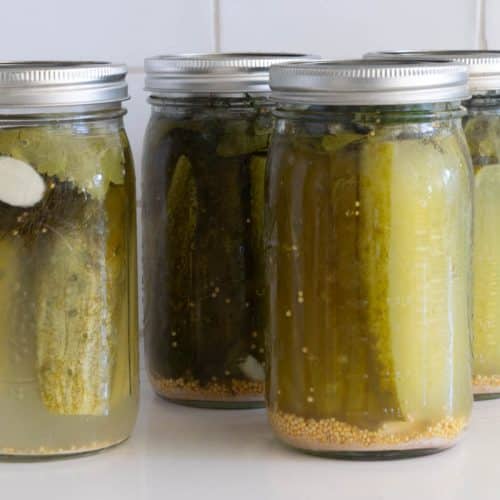
Fermented Dill Pickles
A classic lacto-fermented dill pickle, no vinegar and no canning required. Just salt, water, and time turn crisp cucumbers tangy and full of good bacteria.
Equipment
- Glass Jars
Ingredients
- 2.5 pounds pickling cucumbers
- 35 grams non-iodized canning or pickling salt weighed (See Note)
- 5 cups water unchlorinated
- 4 garlic cloves sliced (or to taste)
- 6 fresh dill sprigs
- 2 teaspoons mustard seed
- 1 Horseradish or grape leaf (or Calcium Chloride) for crispness (See Note)
Instructions
- Trim and soak the cucumbers: Cut off the blossom end of each cucumber. Submerge in an ice water bath for 3o minutes.
- Make the brine: Stir 30 grams non-iodized canning or pickling salt, weighed (not measured by volume) into 5 cups water, unchlorinated until fully dissolved.
- Pack the jar: Add 4 garlic cloves, sliced, 6 fresh dill sprigs, and 2 teaspoons mustard seed to the bottom of your jar. Pack in the drained cucumbers as tightly as you can without crushing them.
- Pour and weigh down: Pour the brine over the cucumbers, making sure they're fully covered. Tuck 1 horseradish or grape leaf, for crispness on top and use a fermentation weight to keep everything submerged below the brine line.
- Ferment at room temperature: Cover loosely and let sit at room temperature, out of direct sunlight, checking daily to make sure the cucumbers stay submerged. (See Note)
- Taste and refrigerate: Once they've reached a tang you like, move the jar to the refrigerator. This slows fermentation way down and the pickles will keep improving in flavor for weeks.
Notes
Salt is measured by weight here instead of by volume because different salts pack very differently. A tablespoon of fine sea salt, Diamond Crystal kosher, Morton kosher, and pink Himalayan can each weigh something different, so a volume measurement can quietly shift the strength of the brine depending on which salt is in the cabinet that day. A kitchen scale removes that guesswork and keeps the brine at a consistent, safe percentage every time. Canning or pickling salt is the most reliable choice since it's pure sodium chloride with no additives, but a non-iodized fine sea salt works well too. Pink Himalayan salt is safe to use but carries trace minerals that don't fully dissolve, so expect some sediment at the bottom of the jar and a faint tint to the brine.
A horseradish or grape leaf works because of natural tannins that help keep cucumbers crisp, but a black tea bag or a pinch of calcium chloride does the same job if you don't have one on hand.
Fermentation time depends a lot on the temperature of your kitchen, warmer rooms move faster, so taste starting around day 3 and let your own preference be the guide.
Nutrition
Serving: 1spearCalories: 4kcalCarbohydrates: 1gProtein: 0.2gFat: 0.1gSaturated Fat: 0.01gPolyunsaturated Fat: 0.02gMonounsaturated Fat: 0.03gSodium: 330mgPotassium: 37mgFiber: 0.2gSugar: 0.4gVitamin A: 28IUVitamin C: 1mgCalcium: 5mgIron: 0.1mg
Well, what did you think?Please rate this recipe here! It helps other readers and also helps to support our site.