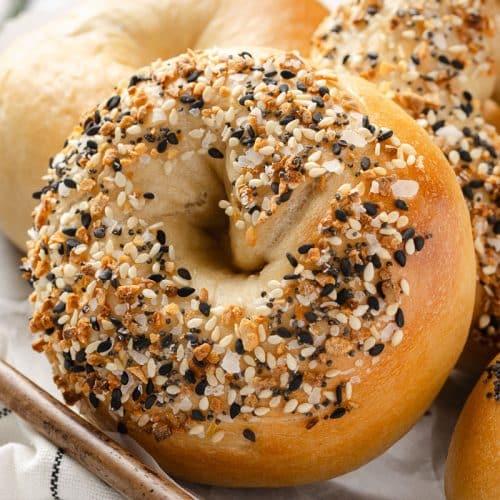
Sourdough Bagels
Sink your teeth into homemade sourdough bagels with a chewy, golden crust and soft interior. An active starter brings gentle tang and depth, while a brief honey‑sweetened boil locks in shine and chew. Toast, top, or freeze—this is your new go‑to bagel for breakfast or sandwiches.
Equipment
- Large pot to boil bagels - 2 quarts or larger
Ingredients
Bagel dough
- 150 grams sourdough starter
- 250 grams water
- 40 grams sugar
- 10 grams salt
- 550 grams bread flour
Water Bath
- 6 cups water
- 1 tbsp honey or sugar
Toppings (Optional)
- Some options are everything bagel seasoning, poppy seeds, sesame seeds, grated cheddar cheese
Instructions
- Start with an active sourdough starter. If you are an active baker, you know when to feed your starter so it is ready. A good rule of thumb is to feed the starter about 12 hours before creating the bagel dough. Just ensure the starter is bubbly and active before using. Scan the QR code for a chart that shows feeding ratios and when you can roughly expect the starter to be ready.
- Combine sourdough starter, water, sugar, and salt in a mixing bowl.
- Using a dough hook, mix in the bread flour. The dough will be stiff, but don't be tempted to add more water. Mix on low, with the dough hook, for 6-7 minutes (or knead 10 minutes by hand).
First Rise
- Cover the dough in the mixing bowl and let the dough rest at room temperature until it doubles in size.At a room temperature of 68℉ (20℃) or less, it should take around 10-12 hours to double in size (which is convenient for an overnight rise). Above room temperature is 70℉ (21℃) degrees, the dough will rise faster and usually takes around 8-10 hours to double.
Shape & Second Rise
- Prepare a baking sheet by lining it with parchment paper.
- Divide the dough into 8 equal pieces and roll them into balls.
- Shape the dough balls using either the “Rope and Loop” or “Poke and Stretch” method.
Boil and Bake
- Preheat the oven to 425°F (218°C) and position the oven rack in the center of the oven.
- Prepare the toppings, if using, by placing them in a shallow container for dipping. Also, prepare a second sheet of parchment to place the bagels on before baking.
- In a large pot, boil 6 cups of water with one tablespoon of honey or sugar and whisk well. The water bath temperature should be about 180-190°F (82-88°C).
- Place one test bagel in a spider strainer and gently add it to the water bath. If it floats within 10 seconds, you are good to continue. Boil the bagels for 60 seconds, 30 seconds on each side. It is easiest to boil no more than 2-3 at a time. If a test bagel won’t float after 10 seconds in the pot, lift it back onto a parchment‑lined tray so it doesn’t soak up extra water. Blot any surface moisture with a clean towel—excess water can make them stick later. Give all the bagels another 15‑20 minutes of proofing before repeating this step
- Remove the bagels from the water with a strainer and rest the bagels back onto the original parchment.
- When the bagels are not too hot to handle, dip the top of the bagel in the topping of choice and set it back on a new sheet of parchment. The new parchment will help so that the bagels don’t stick after baking. You can also use a silicone mat as well in place of parchment.
- Bake the bagels at 425°F (218°C) degrees for 20-25 minutes or until they are golden brown.
Rope and Loop Method
- Roll each ball into a rope or log shape. The dough will need to be long enough to wrap a circle around your fingers, plus an inch or so, so the 2 ends can overlap slightly.
- Adhere the overlapping ends together to create a complete circle (you can use some water to stick the ends if they need more stickiness).
- Using a motion similar to the one used to roll the dough into a rope, roll the 2 ends together making sure they adhere well to each other. Place the circle of dough back onto the parchment for the second rise.
- Cover and let them rise for 30- 60 minutes or until puffy.
Poke and Stretch
- Let the 8 dough balls sit for 10-15 minutes to rest.
- Using your thumb, swiftly press a hole through the center of a dough ball.
- Gently stretch the dough to make a large ring. Work a little section at a time, working around the ring, stretching the dough with both hands. Once stretched, a finger should be able to fit inside the hole. Be mindful that the hole in the center will close up a little after resting and after baking, so you don’t want it too small or the hole will close when baking.
- Place the dough circles back onto the parchment for the second rise.
- Cover and let them rise for 30- 45 minutes.
Notes
Nutrition
Serving: 1bagelCalories: 285kcalCarbohydrates: 58gProtein: 9gFat: 1gSaturated Fat: 0.2gPolyunsaturated Fat: 1gMonounsaturated Fat: 0.1gSodium: 497mgPotassium: 69mgFiber: 2gSugar: 5gVitamin A: 1IUCalcium: 17mgIron: 1mg
Well, what did you think?Please rate this recipe here! It helps other readers and also helps to support our site.